

 Written by TC Team
Held every September, this is the penultimate of Japan’s six annual Sumo Tournaments, known as honbasho. With sumo rankings released a few weeks before, it’s a chance to see the traditional sport up close and personal. The tournaments — which are all official — are held in different cities around Japan, including Tokyo and Osaka.
While the fights are broadcast on NHK, nothing beats the atmosphere of the tense final matches of the day, complete with cushion-throwing and cheers.
Tickets and seats
| Seat Type | Price from | Notes | Booking Options |
|---|---|---|---|
| Arena | ¥3,500 | Likely to sell out early | Ticket Pia (currently unavailable) |
| 2nd Floor (Class B) | ¥22,000 | Includes Guide | Headout (currently unavailable), Viator (limited availability), and Klook (available) |
Advance tickets on the official website go on sale from August 9.
Seating is divided into box seating — tatami areas seating 4 people — which start at around ¥40,000 (for 4 people), and arena seats — which start from ¥3,500, but are more realistically in the ¥5,000–¥10,000 range.
You can also reserve 2nd floor B-class seats accompanied by an expert guide with Headout (available), Viator (available), and Klook (currently unavailable).
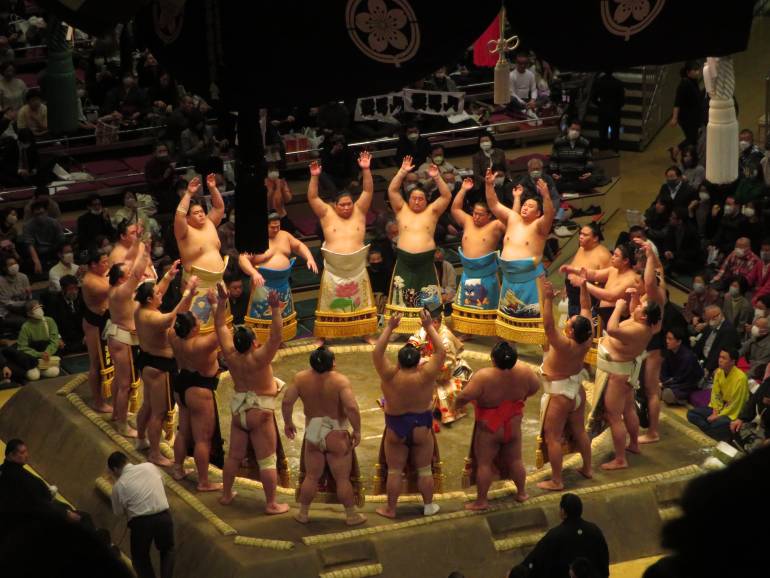
Sumo tournament dates
There are six Grand Sumo Tournaments throughout the year. Not here during a big tournament? Fear not. Here are other ways to see sumo in Tokyo.
Upcoming 2025 sumo dates
- September Tournament in Tokyo: Sept. 14–28 (tickets on sale from Aug. 9, 2025)
- November Tournament in Fukuoka: Nov. 9–23 (tickets on sale from Sep. 20, 2025)
2026 sumo dates
- January Sumo Tournament in Tokyo: Jan. 11–25 (tickets on sale from Dec. 6, 2025)
- March Sumo Tournament in Osaka: Mar. 8–22 (tickets on sale from Feb. 7, 2026)
- May Sumo Tournament in Tokyo: May 10–24 (tickets on sale from April 4, 2026)
- July Sumo Tournament in Nagoya: Jul. 12–26 (tickets on sale from May 16, 2026)
- September Sumo Tournament in Tokyo: Sept. 13–27 (tickets on sale from Aug. 8, 2026)
- November Sumo Tournament in Fukuoka: Nov. 8–22 (tickets on sale from Sep. 19, 2026)
What to expect
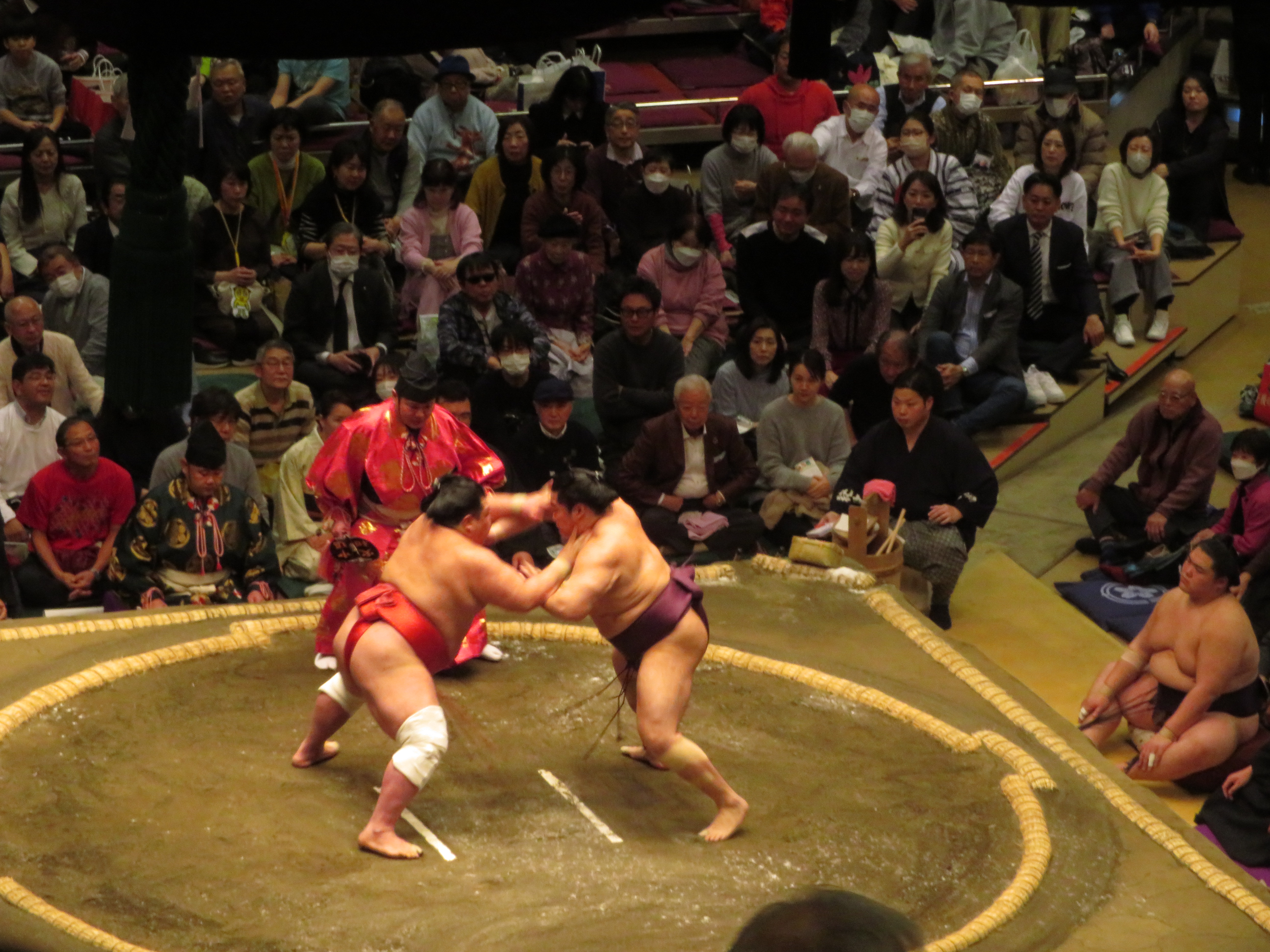
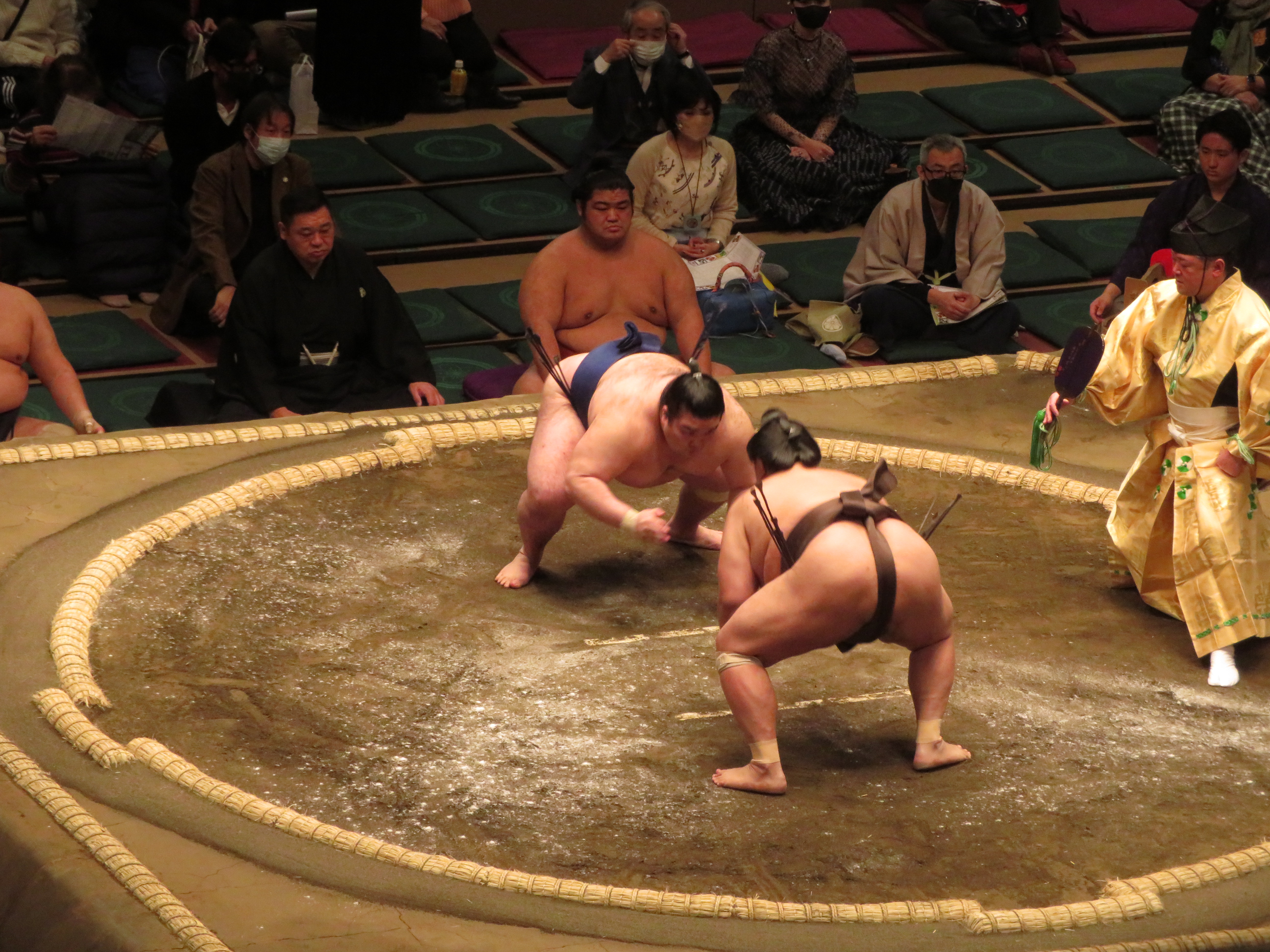
Sumo is a massive — pardon the pun — deal in Japan, and the thrill of the audience during tournaments is contagious. You’ll look down (or up if you’re lucky enough to bag a ring-side seat), on the dohyō (sumo ring) as two sumo wrestlers try to push each other out of the circle by grappling, pushing, and throwing.
Each bout is usually pretty quick, but there are still grip-locked matches that get the heart pounding and the fans rowdy as they cheer on their favorite side.
Daily schedule: What time should I go?
Sumo matches take place throughout the day, and you can leave to grab food and return when you like.
Generally, doors in Tokyo open at 9 a.m. on the first to the 12th day, 10:30 a.m. on the 13th and 14th days, and 10 a.m. on the last day. Note that the morning bouts are reserved for unranked or lower-ranking wrestlers, and so the arena can seem a bit deserted.
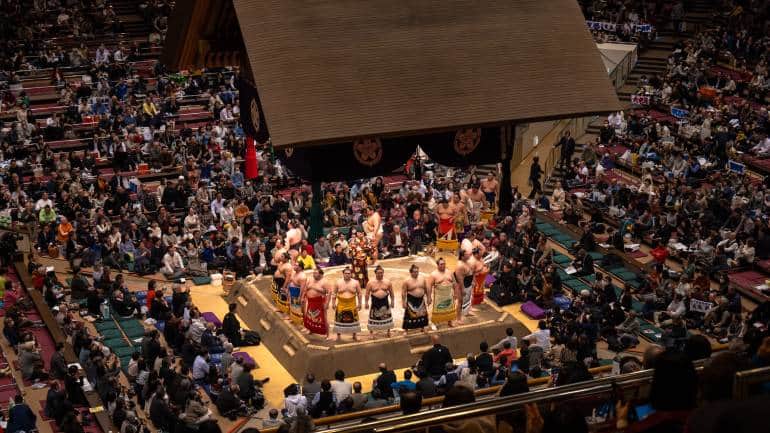
Most of the excitement starts in the afternoon around 2 p.m. when the second-highest ranked division (Jūryō) enters the ring. The highest-ranked wrestlers, the Makuuchi, then enter just before 3 p.m. in preparation for their fights. The current top dog, the Yokozuna, enters the stadium around 4 p.m. and is greeted with calls of “Yoisho!” (an exclamation of effort) from the crowd as he stomps.
Everything comes to a close just before 6 p.m. when a ceremony featuring bow twirling is performed.
The busiest days are, as you may expect, weekends and towards the end of the tournament.
How do the sumo rankings work?
Getting to Yokozuna doesn’t happen overnight.
There are six main sumo divisions: Makuuchi, Jūryō, Makushita, Sandanme, Jonidan, and Jonokuchi (from highest to lowest). Within the divisions, there are also rankings. The one to watch is the Makuuchi division as the order here decides the next Yokozuna — the highest sumo rank. The order goes Yokozuna, Ōzeki, Sekiwake, Komusubi, and Maegashira. Only the Makuuchi and Jūryō divisions have fights every day across the 15-day tournament. The others compete for 7 days.
How do sumo wrestlers move up?
Sumo wrestlers can’t jump several ranks in one go. They must climb up the table.
If you have a good record, i.e., win more matches than you lose in the tournament, you will usually move up a rank or division. Although, as the higher ranks have limited spaces, this might not always be the case. The one who wins the most bouts is crowned the winner of their division. For the Makuuchi, this means you win the whole tournament.
If a wrestler wins two consecutive tournaments, they will be crowned the Yokozuna. Alternatively, they can get the rank by displaying similar high-level performances when they are an Ōzeki. Once a sumo wrestler becomes a Yokozuna, they can not be demoted and remain so till they retire. This means there can be more than one Yokozuna at one time.
Who will be the next Yokozuna?
As of 2025, there are currently two Yokozuna: Hōshōryū Tomokatsu and Ōnosato Daiki (who broke a record for only taking 13 tournaments to become the top). The only Ōzeki at the moment is Kotozakura Masakatsu. He has already won one grand tournament, though his performance hasn’t been the best as of late, so his Yokozuna goal is bleak. (It is very easy to lose the title of Ōzeki if you don’t consistently win.)
What to expect at the September 2025 tournament
The September tournament will be more exciting for the three third-ranked Sekiwake. We will have to see if they have what it takes to move up to Ōzeki.
The previous July Nagoya tournament had a surprise winner in lower-ranked wrestler Kotoshōhō. Top-ranked Yokozuna Hōshōryū and Ōnosato both pulled out with injury, so the pressure will be on both to dominate at the September tournament.
Young Ukrainian wrestler Aonishiki also had a breakthrough tournament in Nagoya with 11 wins to finish as runner-up.
How to get there
The Tokyo sumo tournaments are held at Ryōgoku Kokugikan Stadium. It’s a short 2-minute walk from the West Exit of Ryōgoku Station. Nearby restaurants serve chanko nabe, a large hot-pot dish designed for sumo wrestlers.
Organizers may cancel events, alter schedules, or change admission requirements without notice. Always check official sites before heading to an event.Add to Calendar
- 158 m from Ryōgoku Station Oedo Line (E12)Chūō-Sōbu Line (JB19)
- 0.7 km from Kuramae Station Asakusa Line (A17)Oedo Line (E11)
- 0.9 km from Asakusabashi Station Asakusa Line (A16)Chūō-Sōbu Line (JB20)


